

Our Stories of Change
This article is a collaboration between On the Move and European Theatre Convention.
For most theatre graduates in Europe, the hardest transition isn’t the training itself — it’s what comes after. Isabel Andreen, in charge of international relations at the Théâtre National de Bretagne, Vanja Vasiljevic, who leads artistic development and training at Teatro Stabile del Veneto, and Dr Irene Moundraki, Head of Drama, Library, Archive & International Relations at the National Theatre of Greece and a member of the ETC Board, are developing a new project that starts from that gap: the space between finishing a theatre education and building a professional career, and the years, often the first five, where many young artists simply fall through.
A launchpad, not a blueprint
The project’s idea didn’t arrive fully formed. Andreen traces it back to her own reasons for engaging with the European Theatre Convention (ETC) network in the first place: connecting public theatres with theatre schools, and giving young graduates a clearer path into professional life. Her approach was deliberately incremental — informal conversations first, gradually built into a formal proposal, using the network as a sounding board for issues that cut across borders and institutions, and where the European level can be a relevant space for experimentation while connecting to a wider group of theatre professionals, ETC counting more than 80 theatres in 33 countries.
That groundwork found its match in Dresden. Staatsschauspiel Dresden initiated a cooperative grant application with ETC to bring European theatre students together with mentors drawn from ETC member theatres — at the Fast Forward Festival Forum designed explicitly to bridge academic and professional worlds. Teatro Stabile del Veneto connected to the project through ETC, which it joined more recently, bringing its own three-year post-graduation programme, funded by the European Social Fund, focused squarely on the employability and professional grounding of young artists. The National Theatre of Greece joined for much the same reason, though from a starting point Moundraki describes as considerably harder: geography and language, she notes, have long left Greek theatre somewhat isolated from the wider European landscape, affecting not just how young artists train but how productions circulate and how mobility happens at all. For Andreen, Vasiljevic, and Moundraki alike, the shared interest was the same: the fragile five-year window after graduation, when support tends to disappear just as it’s needed most.
It’s this kind of connection — theatres discovering each other’s parallel efforts through ETC and turning them into something joint — that all three describe as the network’s real value: less a source of ready-made solutions, more a launchpad for collaborations that wouldn’t otherwise have found each other. As Moundraki puts it, being part of ETC is a reminder that Greek theatres are not facing these structural weaknesses alone — and the ETC framework itself has proved a valuable one, with its Next Theatre Generation programme aiming to bridge this gap through a range of schemes and seed-funding support.
Naming the shortage
The numbers back up what practitioners already sense. Research from On the Move shows that only 18.8% of European mobility opportunities are aimed at young and emerging artists (2024 data)[1] — a striking gap given how central mobility is in providing inspiration, networking, and professional opportunities, particularly for younger artists whose national-level offer is limited or non-existent. It’s worth noting, too, that the term “emerging” has different meanings depending on funders and organisers — from artists young in age to more experienced practitioners exploring a particular field for the first time.
In Italy, Vasiljevic points to a funding system that adds its own complications: many opportunities are restricted to artists under 35, an age cutoff she describes as arbitrary and, in practice, a poor proxy for who actually needs support navigating a famously fragmented performing arts field. The 2026 edition of the Cultural Mobility Funding Guide for Italy addresses this challenge: “The Italian system is characterised by a significant amount of project-based funding, with many opportunities combining mobility with artistic production, professional development, and international cooperation. Support tends to be concentrated in specific disciplines, notably the performing and visual arts, and often prioritises emerging artists and early-career professionals. However, access to mobility funding can be uneven across disciplines, career stages, and geographic areas, and information is often scattered across various platforms”[2].
Greece illustrates a more extreme version of the same problem. Moundraki notes that there is virtually no public policy addressing the transition from drama school to professional life, and no legal requirement to hold any formal training at all in order to work as an actor in theatre, film, or television. Of the country’s roughly twenty-seven drama schools, only two are public and tuition-free; the rest are private, of uneven quality, and every year hundreds of graduates enter a profession concentrated overwhelmingly in Athens, where some 85% of the country’s performances take place. In the meantime, the National Theatre of Greece has tried to fill part of that space itself: including young graduates, especially from its own Drama School, in its productions; running a residency programme that sends young artists abroad and welcomes international artists to Greece; and offering what Moundraki calls a “welcoming room” before graduates fully enter the profession.
Taken together, Italy’s age cutoff, Greece’s near-total absence of transitional policy, and France’s own academic-to-professional pipeline are all, in their different ways, local symptoms of the same continental problem: academic training that doesn’t reliably or sufficiently connect to professional practice, and precious little structured help for artists trying to make that leap on their own.
Andreen notes that ETC has moved to formalise its response, folding this work into a broader strategic partnership through the Next Theatre Generation programme and introducing mobility bursaries aimed specifically at students. This was the case, for instance, during the TRANSMISSION programme at the TnB festival in November in 2023, 2024 and in 2025, when five talented young artists were supported through ETC Next Theatre Generation scholarships. It’s a modest start, but one that reflects a shift from ad hoc goodwill toward something more structural.
Why this has to happen at a European level
All three are clear that no single country’s system can fix this alone. A European framework — including mobility programmes, shared mentoring, and cross-border alumni ties — offers something no national reform could: the chance for young artists and theatre professionals to find opportunity outside the borders of a system that failed to make room for them at home. For Moundraki, this matters especially for artists working in more isolated national contexts, where a European network is often what makes exchange, shared practice, and a sense of belonging to a wider artistic community possible in the first place. This is echoed at policy level, too: the European Commission’s Culture Compass names support for the next generation of artists and cultural professionals as a strategic priority for the sector’s future[3], lending institutional weight to what practitioners on the ground are already building.
Moundraki frames the stakes in similarly long-term terms. Without a national support structure, she notes, the gaps in Greece are currently plugged by fragmented, short-lived initiatives — individual efforts that tend to run out of funding before they produce lasting change. Her call is for Europe to think beyond next season’s programming, toward the kind of theatre community it wants to have a decade from now — a long-term vision she sees running through the work Vasiljevic, Andreen, and Dresden’s Fast Forward Festival Forum curator Charlotte von Orti are each developing in their own countries.
That European framing is also what makes room for the project’s cross-cutting ambitions. Andreen and Vasiljevic want the next generation of theatre professionals trained not just in craft, but in the issues shaping the sector’s future: accessibility, gender diversity, environmental sustainability. The idea is to build those questions into artistic training from the outset, rather than treating them as add-ons once a career is already underway — a way of ensuring the practitioners now entering the field are also the ones equipped to change it. The TnB school, for instance, is deeply engaged in supporting students with disabilities, which in turn widens the scope of aesthetics and understanding among all concerned trained future theatre professionals: “A relevant example is the abovementioned TnB School, whose learning environment in Brittany was shaped by the Catalyse company, created in 1994 after ten years of amateur creative practice. The artistic team, composed of seven disabled artists and actors, is fully associated with the development of the CNCA – Centre National de Création Artistique – recognised by the French Ministry of Culture since 2021, under the direction of Thierry Seguin. Each student cohort (three since 2018) is associated with a curriculum-long project alongside the actors of Catalyse/CNCA, through either an artistic creation or creative labs. This programme, called ‘Effractions’ (Breaks-in), is built around a shared stage or joint artistic residency between the company’s artists and the students, helping in turn to broaden the diversity of aesthetics, bodies, and representations on stage”[4].
What comes next
The conversation closed on concrete next steps: a prototype project linking theatre academies across Europe — the Théâtre National de Bretagne, Teatro Stabile del Veneto and the National Theatre of Greece among them — and the beginnings of a European alumni network meant to keep former students connected to each other and to the institutions that trained them, long after graduation. One area for development would be to involve young people themselves in co-designing the mobility programmes and their content, echoing a key recommendation from the mobility funders’ meeting hosted by Latvia’s Ministry of Culture on 28 April 2025[5]. It’s an attempt to turn a five-year gap into a five-year bridge — built not by any one theatre or one country, but by the kind of network ETC has set out to be.
Article by Marie Le Sourd (Secretary General, On The Move) based on interview with Isabel Andreen and Vanja Vasiljevic (21 July 2026) and additional written input from Dr Irene Moundraki. With the support of AI for editing and formatting.
[1] Wilson, C. R., Cultural Mobility Yearbook 2025, On the Move, March 2025: https://on-the-move.org/resources/library/cultural-mobility-yearbook-2025
[2] Cultural Mobility Funding Guide for the international mobility of artists and cultural professionals – Focus on Italy, 2026: https://on-the-move.org/resources/funding/mobility-funding-guide-italy
[3] European Commission, Culture Compass: https://culture.ec.europa.eu/policies/culture-compass
[4] Baltà Portolés J., Dowden S., Wolf K. Learning to Change, The Role of Educational Institutions in Fostering Accessibility for Disabled Artists and Culture Professionals in Europe, On the Move for Skånes Dansteater and Europe Beyond Access, 2025, available at europebeyondaccess.com and on-the-move.org/resources.
[5] Strategic Meeting with Cultural Mobility Funders (28 April 2025, Riga, Latvia) – Key recommendation points to support the mobility of young and emerging artists and culture professionals: https://on-the-move.org/sites/default/files/2025-05/OTM_Forum2025_Mobility-funders-meeting_Report-and-key-recommendations.pdf
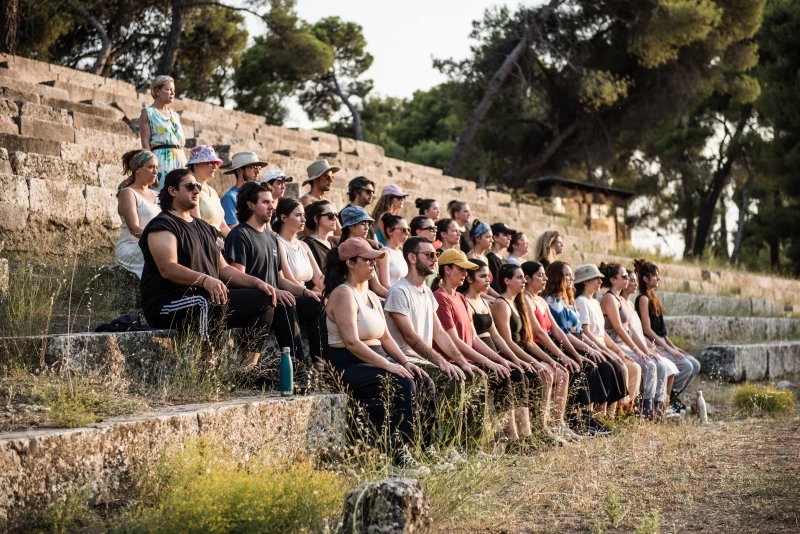
Photo: From National Theatre Greece's 'Sixth International Ancient Drama Workshop' (c) Karol Jarek