
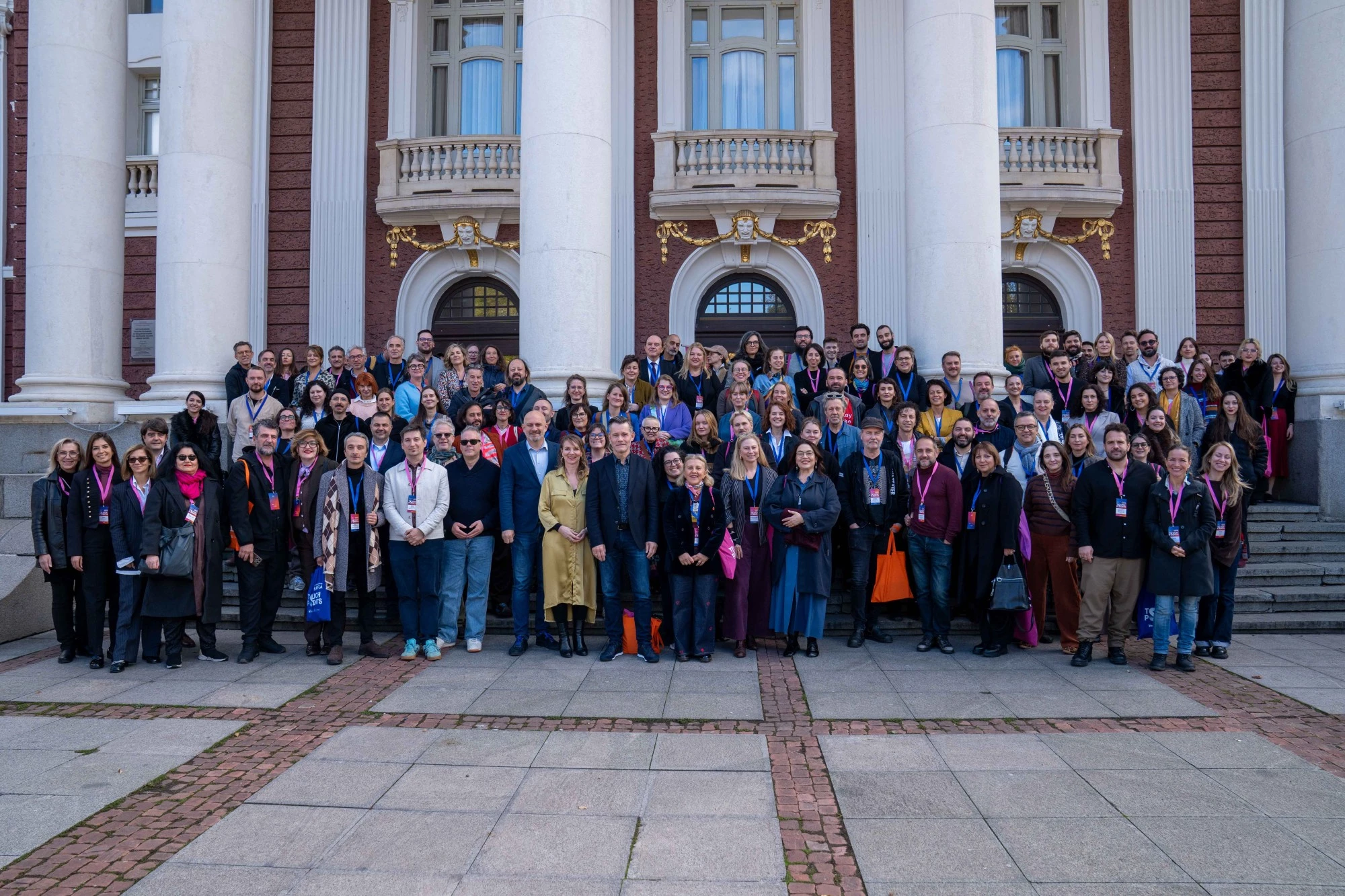
From 5–8 November 2026, the European Theatre Convention (ETC) brought together theatre leaders, artists and performing arts professionals from across Europe for its International Theatre Conference in Sofia, Bulgaria.
Hosted by the Ivan Vazov National Theatre under the theme “Touchpoints: Artistic Freedom, AI & Collaborative Futures in Theatre,” the four-day gathering explored how theatres can respond to political, technological and societal change while strengthening the human connections at the heart of their work.
Conference Photos Conference Videos
Sofia Sends a Message of Solidarity across Europe
The conference carried particular significance as it marked the second anniversary of the attacks on the Ivan Vazov National Theatre on 7 November 2024. Two years later, the same theatre became a meeting place for European solidarity, artistic exchange and renewed commitment to protecting artistic freedom.
The conference also struck a chord well beyond the theatre community; media coverage of the conference has already reached nearly one million estimated contacts in Bulgaria.
The conference concluded with a powerful appeal from its host, Vasil Vasilev, General Director of the Ivan Vazov National Theatre:
"It is an enormous honour for Bulgaria and for our National Theatre to have brought together such a large European theatre community. Two years ago, we faced attempts to silence our stage. Today, in a world increasingly divided by walls and fear, we have demonstrated something radical: that theatre can resist isolation through openness, dialogue and solidarity. Our responsibility is to give a voice to those whom history has silenced and to defend artistic freedom against every attempt at censorship. My message to our colleagues across Europe is simple: when you go home, protect your theatre."
ETC Executive Director Heidi Wiley reflected on the significance of returning to Sofia:
“This stage, which was supposed to be silenced, is no longer silent. Instead, it is bringing all of Europe together — an act of solidarity, but also a very powerful act of humanity. Two years after the attacks, we can see how a moment of crisis helped spark a European movement. We have taken artistic freedom from grassroots mobilisation onto the European political agenda. Our responsibility now is to turn that solidarity into lasting protection for theatres and artists across Europe.”
ETC Vice-President Tom Leick-Burns, Artistic Director and General Manager of Les Théâtres de la Ville de Luxembourg, emphasised the importance of international cooperation:
“At a time of growing political uncertainty, international theatre networks are more important than ever. By connecting theatres across national and linguistic borders, we can respond to shared challenges, create new opportunities for collaboration and strengthen theatre’s role as a space for dialogue and cultural exchange. What we have experienced here in Sofia demonstrates the strength of that commitment.”
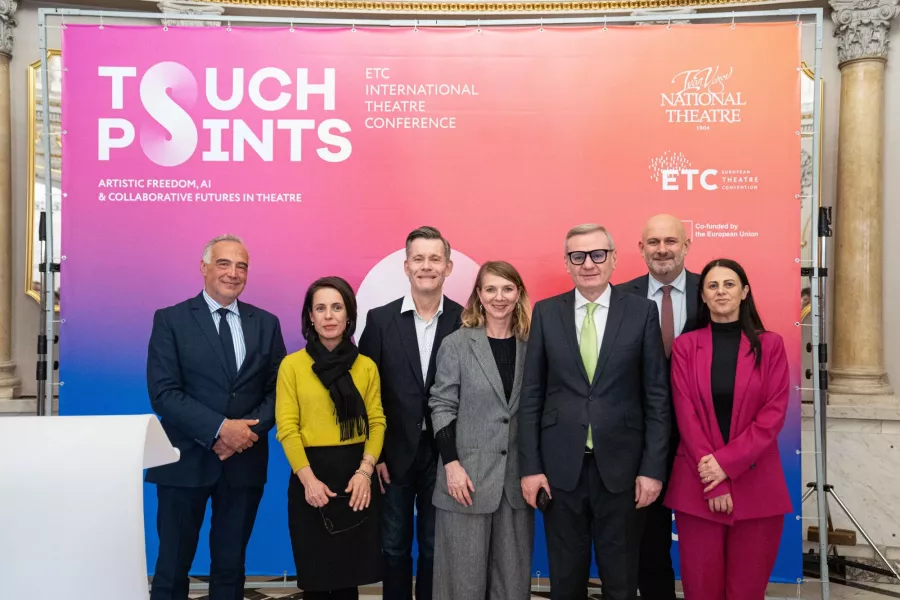
(l-r) Anton Kutev – Chair of the Committee on Culture and Media in the National Assembly; Irina Dakova – Deputy Mayor for Culture and Tourism, Sofia Municipality; Tom Leick-Burns, ETC Vice-President, Artistic Director and General Manager of Les Théâtres de la Ville de Luxembourg; Heidi Wiley – Executive Director of the European Theatre Convention; Evtim Miloshev – Minister of Culture of Bulgaria; Vasil Vasilev – General Director of the Ivan Vazov National Theatre; Marina Vasileva – Deputy Minister of Culture of Bulgaria (c) Stefan Zdraveski
Opening Ceremony Brings Together Bulgarian Political and Cultural Leaders
The conference officially opened with a ceremonial event bringing together leading representatives of Bulgarian politics and culture alongside representatives of the European Theatre Convention and the wider European theatre community. Distinguished speakers included Anton Kutev, Chair of the Committee on Culture and Media in the Bulgarian National Assembly; Evtim Miloshev, Bulgaria’s Minister of Culture; Marina Vasileva, Deputy Minister of Culture; and Irina Dakova, Deputy Mayor for Culture and Tourism of Sofia Municipality.
Artistic Freedom: From Solidarity to European Action
The panel “Public Theatre in a Changing Europe: Between Identity, Responsibility and European Collaboration” examined pressures facing public theatres, from political interference and censorship to financial insecurity, and explored the role of international cooperation in strengthening institutional independence.
Ahead of the panel, participants were welcomed in a video address by Georg Häusler, Director for Culture, Creativity and Sport at the European Commission. The discussion then opened with contributions from Vasil Vasilev, Heidi Wiley and Nela Riehl, Member of the European Parliament and Chair of its Committee on Culture and Education, who addressed participants by video. Watch videos here.
Moderated by Marina Maleni, General Director of the Cyprus Theatre Organisation (THOC) and ETC Board Member, the discussion brought together Rui Catarino, President of the Executive Board of Teatro Nacional D. Maria II (Portugal); Irene Moundraki, Head Dramaturg and Head of Archive, Library and International Collaborations at the National Theatre of Greece and ETC Board Member; Lotta Lekvall, CEO of Folkteatern Göteborg and ETC Board Member (Sweden); Zuzana Hekel, Director of Divadlo Jána Palárika (Slovakia); and Michael De Cock, General and Artistic Director of Théâtre de Liège (Belgium), who contributed by video.
Participants explored the progress of the RESISTANCE NOW TOGETHER campaign and the call for a European Artistic Freedom Act, alongside practical steps theatres and networks can take to defend artistic independence. Speakers highlighted the importance of sustainable public funding, solidarity across borders and the collective responsibility of cultural institutions to defend their public mission.
The conference also featured a keynote address by Bulgarian theatre and film director Galin Stoev, reflecting on theatre’s place in a changing European society.
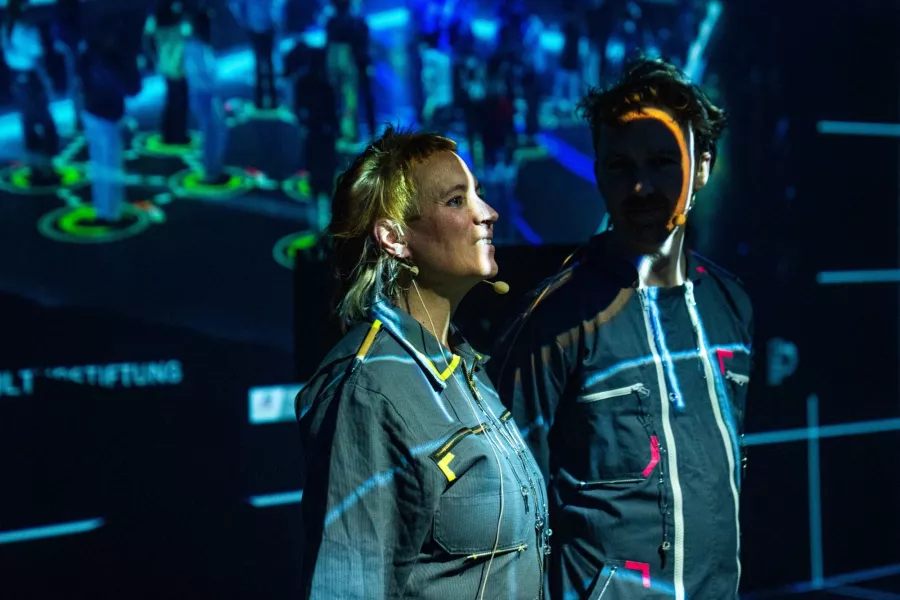
Nina Maria Stemberger and Birk Schmithüsen of ArtesMobiles lead an interactive session during the Conference (c) Stefan Zdraveski
Artificial Intelligence: Keeping Humanity at the Heart of Theatre
The second major conference panel, “How AI Is Changing the Way We Make Theatre,” explored the opportunities and challenges artificial intelligence presents for the performing arts.
In a keynote opening with the provocative phrase “To be or to seem to be,” Sarah Nicole, a lecturer at Sciences Po and an expert in emerging technologies, examined the relationship between theatrical illusion, human identity and AI’s increasingly sophisticated simulation of human behaviour.
Moderated by Nicole, the panel featured Marcus Lobbes, Director of the Academy for Theatre and Digitality in Dortmund; Pierre Lungheretti of Chaillot – Théâtre national de la Danse in Paris; media artist Birk Schmithüsen of ArtesMobiles; and Swedish director and artist Jonathan Silén.
The discussion addressed AI in artistic creation, production and theatre administration, while raising questions about authorship, ethics, human agency and the role of artists in shaping technological change.
Participants stressed the need to empower theatre professionals to engage critically and creatively with AI, rather than simply adapting to technologies developed elsewhere.
Go deeper: https://www.europeantheatre.eu/all-news/etc-helps-shape-eu-ai-strategy-for-the-cultural-sector
From Dialogue to Collaboration: Building the Future of European Theatre
Beyond the main panels, the conference offered professional exchange, artistic encounters and collaborative formats designed to turn shared challenges into practical opportunities.
Deep-dive roundtables explored artistic freedom in an age of political distrust, the role of theatres as public spaces, European solidarity networks and the future of public theatre institutions.
Additional sessions and laboratories addressed digital theatre, artistic courage, accessibility, diversity, international mobility and new approaches to theatre management and collaboration.
Collaboration Speed Meetings and Future Laboratories created opportunities to exchange expertise, develop ideas and build partnerships across borders. Performances at the Ivan Vazov National Theatre introduced guests to Bulgarian theatre.
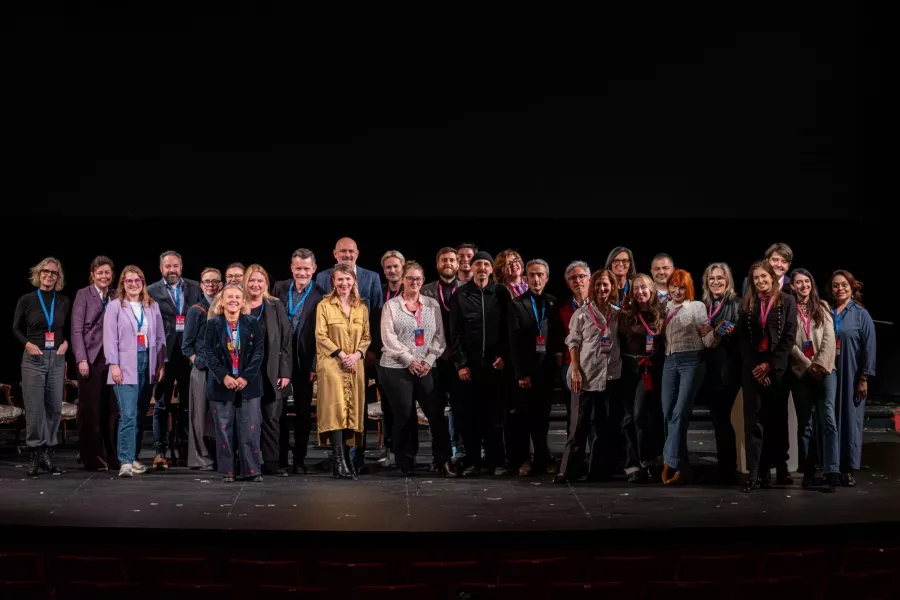
New ETC Members are joined on stage by the ETC Board (c) Stefan Zdraveski
Eight New Member Theatres join the ETC Community
The conference marked an important moment of growth for ETC, with eight new member theatres welcomed during the General Assembly, bringing the organisation to more than 90 member theatres across over 30 European countries.
The new members include:
- Youth Theatre “Nikolay Binev” — Sofia, Bulgaria
- “Geo Milev” Theatre — Stara Zagora, Bulgaria
- Dejvice Theatre — Prague, Czech Republic
- Aalborg Teater — Aalborg, Denmark
- Mikheil Tumanishvili Film Actors Theatre — Tbilisi, Georgia
- Piccolo Teatro di Milano – Teatro d’Europa — Milan, Italy
- Teatro Nacional São João E.P.E. — Porto, Portugal
- Borås City Theatre — Borås, Sweden
Media photos are available here.
Contact:
Amy Pradell
Senior Strategist for Communications, Fundraising and Advocacy
European Theatre Convention (ETC)
apradell@europeantheatre.eu